The Secret Art of Travel


To the eyes only looking hurriedly to the goal,
The sweetness of roaming cannot be savoured.
Forests and streams and all of the magnificent spectacles waiting along the way
Remain closed off.

Herman Hesse


The beautiful and serene Ballagan Burn near Strathblane.


The Empty City [A Postcard from Kazakhstan]

For the last several years, during the sharp, luminous months of Glasgow's mind - roughly from the end of November to the end of February - when the earth collects the sun's rays at such an angle as to highlight areas of the city hitherto unseen, I have been compiling a photo-poetic volume entitled The Empty City. This emptiness is an allusion to the fact that a city like Glasgow spends much of its time, contrary to popular belief, in a state of emptiness and silence (think of the night-times, those wet and windy days, even the sunny days when people are crammed into their pokey little offices). It's like a desert that, again contrary to conventional wisdom (which of course isn't wisdom at all but mere cleverness), spends most of its time not in boiling temperatures, but, rather, in a state of sub-zero coolness.

Anyway, here at the end of November, I am not even in Glasgow, and yet it resonates across the continents to be with me. The map is not the territory, I am. 

I am in Kazakhstan, teaching.... and learning. And here the light of Central Asia is sharp, and reminds me of the too few days when Glasgow becomes super-still and clear, full-sun-skied. Because of the flatness here, there is little to disrupt the pattern of the weather, so for the last 3 weeks it has been full sun in a full blue, largely windless sky. It has also been around minus fifteen degrees celsius, which if you wrap up and take into consideration the absence of any wind-chill factor, is actually not that cold. Yet, as I am forever telling my students who have been weaned on the wasteful and soporific effects of too much indoor heating, is fantastic for being awake (or if you prefer, awake being).

And so Glasgow is with me, even here. But why shouldn't it be, if, after all, Glasgow, from years of roaming and embedding myself in her hills and moors and buildings, has become me as I it? Glasgow travels as I travel. Glasgow goes where I goes....

And here, across the vastness of the great Eurasian steppe, there is silence and there is emptiness:

"Being and silence belong together." Max Picard

Silence is the soil
in which faith can grow:
faith as openness
faith as con-science.
The reality of silence
is that
silence is reality:
a relief of immediacy
an immediate relief.
The tongue we speak today
is no longer a mother tongue
but an orphaned one,
we mumble and mutter
in a wasteland of words
meaningless patterns, vicious
circles, noise-filled networks
in mere mud-cluttered minds.

Being and silence belong together.


 Ice-fishing on the Ural River.


Cool, Calm, Collected: The Coolness of Nature & Living Less

Cultivation runs to simplicity; half-way cultivation runs to ornamentation.

Bruce Lee


The original way needs nothing to be added, nor is it clogged up. It perfectly suffices in itself. Because human beings have the ability to think, they always want to add something, and soon everything gets clogged up.

Zen Master Kosho Uchiyama


The epitome of cool alas! is not Steve McQueen’s ride in Bullit but something far simpler, far less mechanical, some-thing that is in fact no-thing. I am of course speaking about Nature.

NATURE at large, whether a river, a hill, or a wood, exudes a coolness that one can feel as one approaches. I’m talking here primarily of coolness as a temperature as opposed to coolness as an aesthetic of attitude. Although, the attiude of a forest to remain where it is against all the odds, to remain standing and not to flee in the face of its murderers, is probably the epitome of cool as that aesthetic of attitude.

This coolness (whether attitude or temperature) is the exact opposite of the city’s heat island effect (and cringeworthy self-infatuation) where the temperature of the metropolis due to all that ‘hot air’ and wasted energy (all that fashioning and manufacturing) is a few degrees greater than the surrounding countryside. It’s not that the wood feels cool in comparison to the city, but that it is cool in its own right. Approach a forest, a mountain, or a river, preferably during summer or spring, and you will feel it, this exudation of coolness which in itself is a vision of calmness, and collectedness (where all things are bound together in this wasteless, self-enclosed ecosystem). It’s attitude too - ‘better to live on your feet than die on your knees’, ‘we shall not be moved’ - is cool in its uncompromising tone.

Where humans seem to achieve coolness with self-conscious aplomb, trees achieve it without. In other words, humans try to be cool, and in so doing, negate the very essence of coolness. Trees (or equally, rivers, and hills), in their absolute nakedness make no such effort. They simply are, and as a consequence, they are cool. There’s no trying, no ornamenting, no fashioning. At least, not from without. Humans, on the other hand, appear to think that coolness only comes from without, from what you put on, from how you decorate the self from the outside. But it’s not. That, I’m afraid, is just the wool that has been pulled over your eyes (as well as over the rest of your body) by those keen to exploit you, to profit from selling you the bells and whistles. There’s simply no money to be made from decorating you from the inside out, naturally. It’s all about the glittering surfaces, the coolness of man. But this is artifice. Identity is not what you put on, but what you take off.

It is one of the great illusions of the modern world - the greatest trick the devil ever played - the standalone identity of man as a ‘unique’ individual. Even the word ‘individual’, for anyone that still has some command of language beyond the limited syntax of a metaphysically illiterate society, tells us in no uncertain terms of our essential undividedness. If there is an identity, in other words, it is not that of a disintegrated ‘unit’ as we have come to know it, but as an integrated unity that sees the self and its environment as a single evolutionary event. As the Polish poet Czeslaw Milosz once wrote in a poem he entitled Learning:

To believe you are magnificent.
And gradually to discover that you are not magnificent.
Enough labour for one human life.

Real coolness needs nothing to improve it. Not even magnificence. Life itself is cool. Why should you have to add to it? Unless of course you’re under the illusion that you ‘need’. But ‘need’ is another illusion, another PR ploy that has been blown out of all proprtion for the sake of a self-destructive economic system predicated upon growth and greed.

If there were ever an adjective that could smite the coolness of man in one fell swoop it is ‘needy’. ‘Be more dog’ huge billboards scream out, the mantra of the west. Presumably, that translates as be more needy, be more dependent, be more excitable, and quite frankly, be more stupid.

‘Don’t ever tell me that you need anything’ a Zen master famously tells his pupil. Essentials like food and water, sleep and shelter, even simple clothing, is not need. It is essential. It is a necessity. But anything that is not essential, which is more or less the vast part of capitalism’s undertaking, is need. And need is not cool. Need causes dependency, pathology, obsessiveness, unhealthy attachment and addiction. It causes the brain to turn to mush.

To be sure, within the concocted lexicon of the modern day state (a modern day state predicated upon selling), ‘need’ is often portrayed as ‘quirkiness’ or ‘zaniness’ or simply eccentricity. In other words, need, like greed, according to the market, is good. Need helps the economy grow. Need makes you more comfortable. Need helps others. But of ourse this is just another fatuous rationalization on behalf of the market. Need may well help the economy grow but at what cost? Alas! the planet is not an infinite resource, and even if it were…

If there is a 'need' and an essential requirement for man, it is, as Theodore Roszak eloquently points out in The Cult of Information:

... our need to become serious human beings, people who grow by virtue of having struggled in the solitude of the heart to find both moral dignity and personal meaning. It is our need to live deeply, to take life in our hands, to weigh and feel it, to give it deliberate shape - our own shape, the shape of our peculiar experience. Debased consumer fantasies, selfish acquisitiveness, the careerist rat race, the corruptions of elitism: these are surely among the forces that thwart our need to grow.

So… man is not cool, for he is in a constant state of illusory need, whilst disregarding the essential requirement he needs the most. He is demented, for he has been removed of his own mind (the decline of civilizations begins with a decline in metaphysics and the eco-philosophic spirit). He is like a caged lion that has spent too long behind bars and has taken to chasing and eating its flea-bitten tail. Man now takes his cues not from the great teacher herself, Nature, but from tabloids, chat shows and corporations.

The human has lost his cool. And become Man (emphatically capitalised).

On the metaphysical front, man’s coolness has, by the looks of it, been destroyed altogether, coolness as collectedness and the ability to see events from an unself-conscious and wide-angled perspective. The Greek stoic philosopher Epictetus was a great believer in accepting one’s fate calmly and dispassionately and viewing life from a broad perspective, living one’s philosophy without making a song and dance about it. He is known for his essentialist manifesto and his eagerness to simplify life to the limit, stripping it of superfluities and non-essential ingredients.

With a global population now in excess of 7 billion people and still climbing, and in spite of the astonishing scientific advances and economic progress of the modern world, worldwide suffering and inequality is still commonplace. Indeed, it is now estimated, at the onset of the third millennium, and in spite of the last half century’s efforts to reduce the inequality gap, that just 80 people, with their combined wealths, ‘own the world’.

Writing in his autobiography, Joy in Living, in 1957, the Scottish Thoreau and life-long advocate for the simple life, Dugald Semple, remarks: It is said that the Persian Empire decayed when 1 per cent of the people owned all the land, and that when Rome fell, 1,800 men owned all the then known world.

Civilization is on the edge of the precipice (yet again), having, apparently, learned nothing. So much for science and progress, and ‘civilization’. But then civilization is, paradoxically, midst our image-blasted and ocularcentric societies, not so much the art of looking at but the art of looking away, or, at the very best, the art of tele-vising and watching from a (safe enough) distance. The commodification and packaging of the individual (physically through fashion and narcissism, and metaphysically through scientism and desecration) has led man to think of himself as a finite, standalone entity. He has removed himself (and allowed his self to be removed) from nature, whilst embedding himself in concrete. He has degraded the soils and seas, treated the land like a rubbish tip when it isn’t a lumber yard and theme park, and sold his self out to the lowest bidder, occasionally tax deductible. He has sold his wings for wheels, and his eyes for screens. He can no longer entertain himself but rather needs to be entertained. His work furthermore has no bearing on his living and his philosophies are garnered from cereal boxes and TV chat shows. A century and a half ago the German philosopher Nietzsche created a stir with his pronouncement of the death of god. But it wasn’t really god that had died. It was the human in which god had been living. As far as that’s concerned, it might not be so far-fetched as to suggest that the human (man + humus) is already dead, and that people, zombified by the seduction and manipulation of an economic system predicated upon patheticness, are simply grotesque versions of their original selves with little or no capacity for independent thought.

The coolness of being human has long disappeared beneath the nonsense of man.

So what to do?

Semple, like most apostles of simple living, advocated a living closer to nature, getting out into the open air, daily walking and contact with the soil, healthy eating, and what he called ‘living biologically’. ‘We must live according to the eternal laws of life, and get rid of all this false science and craving for stimulation…’

‘To make a better world, we must aim at creating not so much better engineers but better men and women’.

Before architects and teachers, what we need are whole men and women, healthy and open-minded. ‘We cannot have architecture embodying wholeness until we have architects who are whole,’ writes Henryk Skolimowski in Living Philosophy.

In other words, go out into nature and learn from it: learn from its coolness, listen to its calmness; observe its less-ness: its wastelessness, its anxious-less-ness, its PR-less-ness, its deathlessness - there are vast lessons to be learned here, lessons that you will rarely encounter in a grasping, dualistic, and fragmented man-filled world.

Collect your self beyond the nervous energy of the city, and the cling-filmed package that you have been fashioned into, and enter your self…

Get beyond the con-fusion that has elided the small self with the indefinite self…

Question the ethics of the city…

Question the difference between man and hu-man…

Live less. Be cool!

‘Frugality is not a depressing abnegation and self-denial’, writes Skolimowski, but a positive manifestation of new qualities; only then will it become elegant frugality’.

‘Self-limitation’, writes Alexander Solzhenitsyn, ‘is the wisest and most fundamental step of a man who has obtained freedom. It is also the surest path towards its attainment.’

The orgy of excess has gone on long enough. Growth is not simply the accretion of matter around a nucleus, but a matter of inner maturity. Coolness eschews the superfluous and extraneous. Existential growth is metaphysical not material.

True coolness is nakedness.

'All our troubles began', writes Semple, 'when we put on clothes'.


A Presentation of Humanity on the Autumnal Kilpatrick Braes.....


Living the Semple Life


Earlier this year I came across for the first time the curious Scottish character of Dugald Semple. I am amazed I came across him at all since he seems, like most live-minded advocates of a less industrious life, to have been relegated to library archives, if not to the burning scrap heap itself.

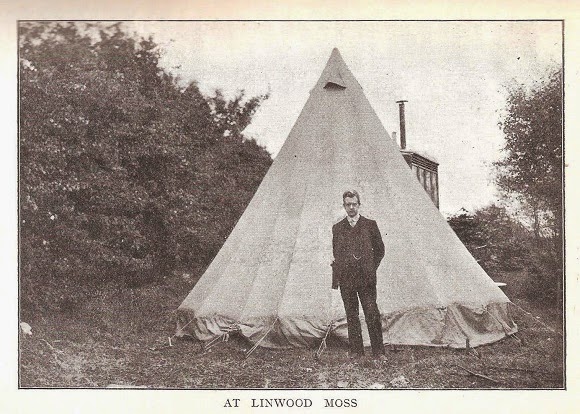
Semple (1884-1964) lived at various times in Bridge of Weir, Linwood Moss, Beith, and Fairlie where he had some correspondence with, and influence on, a young Kenneth White. Semple became known as a result of his living in a 'wheelhouse' (an old omnibus) on Linwood Moss for a year when in his early twenties. It was his Thoreauvian attempt to 'live deliberately' and to question the seemingly self-detructive tendencies and conventions of a slipping society.


Semple was, as I am too, convinced that the human had lost his way, had become so confused (eliding the illusory me with the I) that he had now become something else, that was emphatically not human. The word human, indeed, comes from the Latin humus meaning soil, and since man has degraded the earth's soils to the point of death, one could say, from a simply linguistic viewpoint, that the word human is no longer applicable. Soil and soul, the title of another significant book in the simple life canon by the thoughtful Scot Alistair McIntosh, tells us of how we have estranged ourselves from our selves; how by way of seduction and progress and the dogma of religion we have become the small ego-bound 'me' instead of the wide, all seeing I. Religion, whether you like or not, is the deep interconnecting forces that binds all sentient and non-sentient things together. Whether the Tao, the Force, the unseen, or the invisible, it is there and connects. How do you think you breathe? if not for the truth that your self is larger than you think it is? As an open flowing system, the world flows right through us as we flow through it. World, then, becomes a reciprocal process, not a product or commodity to be exploited. Spit on the earth, goes an old Amerindian saying, and of course you spit on your self. But we have lost our way. We are actively encouraged to 'spit on the earth' as it contributes towards GDP. Progress has advanced us beyond (not in any transcendental way, but simply in an accumulative physical one) the human into the post-human. And, as the word 'posthumous' suggests, as the proliferation of zombie films do too, we are the walking dead. We are not alive, not awake, not aware. We go about our busyness, unthinkingly, concerned only with our small self. Man has lost his humanity, sold it out in most cases to the lowest bidder (about 7 quid an hour), for humans do not kill, they do not deceive, they do not degrade, and they waste very little. The death of the human is upon us, that much is clear. But it needn't be that way. The simple life can return us to the source, can wake us up from this primitive accumulating slumber we are immersed in. Stillness, and contemplation, as the anti-thesis to business (and the state of being busy) is the way to the Way. Solitude and silence, the opening of the transcendent door.


For the butterfly has leisure to love the lotus, not the bee busily storing honey. [Rabindranath Tagore]


Crow Council

Almost all animals speak. They speak in codes that we do not understand at first. They speak about danger and mates and young. They speak of life and death, of life coming out of life. Much of their passion is embedded in these signals that they send out to the world. With all our intelligence we hear these signals and strain to decipher the codes. We live in a world of messengers that we have only begun to hear. 
Joseph Mortenson, Whale Songs and Wasp Maps

The other night, Wednesday 17th September 2014 (the night before the Scottish Referendum), a group of carrion crows gathered on the rooftop of the neighboring tenement. Their raucous crowing (counselling) could be heard for the next 30 minutes.


It was an unprecedented sight. At one point there were 21 crows congregated within very close proximity to each other. Each appeared to be agitated by something. Maybe there was a bird of prey lurking out of my field of view. Maybe something else was up. I don't know. What I do know, is that in my 5 years of living here and keeping an eye out for birds of all kinds (and having a special relationship to the crow from my 3 years living in 'the city of crows' of Warsaw, Poland) I have never seen anything like it. At best, there are a couple of crow families that live in this area, and they always keep themselves to themselves, only rarely taking to the chimneys and roofs to voice any concerns. But, the other night, as if to voice their concerns about an independent Scotland, they could not have been more vocal or numerous. It was a very strange experience, and yet at the same time, a very interesting one. I kept thinking about the lone crow who instigated it all, and within seconds seeing all these other crows come in. It was this same crow who was left at the end, on the aerial, periodically crowing to the four winds, as if something or someone had been lost. 

At any rate, it was a fascinating 30 minutes, to behold the behaviours of these fascinating birds.


Flourishing in the Fossil Grove


Plants are not totally unlike us... Joseph Mortenson, Whale Songs & Wasp Maps

A child said, 'What is grass?' fetching it to me with full hands;
How could I answer the child? I do not know what it is
any more than he.    

Walt Whitman, Leaves of Grass


Mid-August in the Fossil Grove, the only in situ site in the world of an ancient forest whose tree stumps, some 330 million years old, have been petrified with the passage of time. In terms of 'slow flows' this is pretty much it. When these trees were alive and well, 'Scotland' was somewhere near the equator enjoying tropical temperatures and teeming jungles. 


A third of a billion years later....

Indeed, it got me thinking... this peace and serenity.... this deep time...

and all these flowers:


Maybe the Earth is one big flower - after all, it does flow and flourish (in spite of all our efforts) - which springs forth from the solar and stellar soil of our galaxy. All the other planets could be plants too, except, and in spite of their flowing too, they don't appear to have the right conditions for flowering.

Moreover, if the planet Earth is a plant (in or out of flower), humans and every other living creature on Earth would then be considered as epiphytes: plants which grow on other plants. To be sure, humans, especially the more 'modern' we become, have turned out to be more parasitic towards our host than symbiotic. This might be explained by our deluded view of ourselves as something other than plants (some of which flower and some which do not), and flow-ers. Indeed, if we were to (contemplate and) compare a human and a plant (any human, any plant) we might find that they have more in common than at first sight.

'Our failure to see plants as living creatures', writes Jerry Mander in Four Arguments for the Elimination of Television, 'is the result of limited human perception, a sign of the boundaries of our senses or the degree to which we allowed them to atrophy, or the fact that we have become too speedy to perceive the slower rhythms of other life forms'.

If we did slow down, and open up that organ of contemplation within us, we might understand the earth and our place within it quite differently. All flesh is grass after all, and though the flesh may wither and the flower may fall off, Earth - soil of soils - and Universe - synergy of synergies - will endure.


I think having an intimate 'love affair' with a flower is far more psychotic and riveting than having a love affair with some of the more banal creatures of the human race.
Timothy 'Speed' Levitch, The Cruise


Alive Slow!


In his book, Desert Solitaire, the outspoken essayist and environmentalist Edward Abbey writes about movement and its capacity to distort how and what we see:

In the first place you can't see anything from a car; you've got to get out of the goddamned contraption and walk, better yet crawl, on hands and knees, over the sandstone and through the thornbush and cactus. When traces of blood begin to mark your trail you'll begin to see something, maybe. Probably not.

Slowness is the key to seeing! (But not so slow that you begin to atrophy)...


From the Erskine Bridge....