Living the Semple Life


Earlier this year I came across for the first time the curious Scottish character of Dugald Semple. I am amazed I came across him at all since he seems, like most live-minded advocates of a less industrious life, to have been relegated to library archives, if not to the burning scrap heap itself.

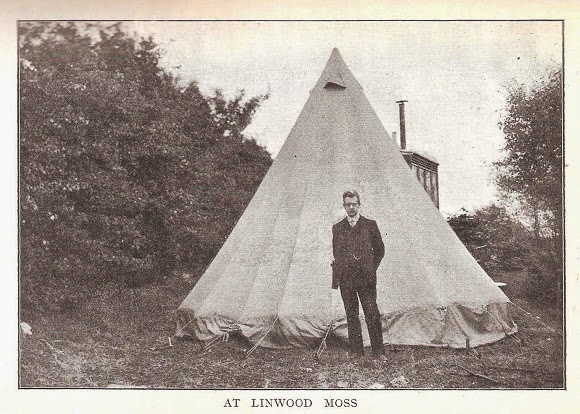
Semple (1884-1964) lived at various times in Bridge of Weir, Linwood Moss, Beith, and Fairlie where he had some correspondence with, and influence on, a young Kenneth White. Semple became known as a result of his living in a 'wheelhouse' (an old omnibus) on Linwood Moss for a year when in his early twenties. It was his Thoreauvian attempt to 'live deliberately' and to question the seemingly self-detructive tendencies and conventions of a slipping society.


Semple was, as I am too, convinced that the human had lost his way, had become so confused (eliding the illusory me with the I) that he had now become something else, that was emphatically not human. The word human, indeed, comes from the Latin humus meaning soil, and since man has degraded the earth's soils to the point of death, one could say, from a simply linguistic viewpoint, that the word human is no longer applicable. Soil and soul, the title of another significant book in the simple life canon by the thoughtful Scot Alistair McIntosh, tells us of how we have estranged ourselves from our selves; how by way of seduction and progress and the dogma of religion we have become the small ego-bound 'me' instead of the wide, all seeing I. Religion, whether you like or not, is the deep interconnecting forces that binds all sentient and non-sentient things together. Whether the Tao, the Force, the unseen, or the invisible, it is there and connects. How do you think you breathe? if not for the truth that your self is larger than you think it is? As an open flowing system, the world flows right through us as we flow through it. World, then, becomes a reciprocal process, not a product or commodity to be exploited. Spit on the earth, goes an old Amerindian saying, and of course you spit on your self. But we have lost our way. We are actively encouraged to 'spit on the earth' as it contributes towards GDP. Progress has advanced us beyond (not in any transcendental way, but simply in an accumulative physical one) the human into the post-human. And, as the word 'posthumous' suggests, as the proliferation of zombie films do too, we are the walking dead. We are not alive, not awake, not aware. We go about our busyness, unthinkingly, concerned only with our small self. Man has lost his humanity, sold it out in most cases to the lowest bidder (about 7 quid an hour), for humans do not kill, they do not deceive, they do not degrade, and they waste very little. The death of the human is upon us, that much is clear. But it needn't be that way. The simple life can return us to the source, can wake us up from this primitive accumulating slumber we are immersed in. Stillness, and contemplation, as the anti-thesis to business (and the state of being busy) is the way to the Way. Solitude and silence, the opening of the transcendent door.


For the butterfly has leisure to love the lotus, not the bee busily storing honey. [Rabindranath Tagore]


Crow Council

Almost all animals speak. They speak in codes that we do not understand at first. They speak about danger and mates and young. They speak of life and death, of life coming out of life. Much of their passion is embedded in these signals that they send out to the world. With all our intelligence we hear these signals and strain to decipher the codes. We live in a world of messengers that we have only begun to hear. 
Joseph Mortenson, Whale Songs and Wasp Maps

The other night, Wednesday 17th September 2014 (the night before the Scottish Referendum), a group of carrion crows gathered on the rooftop of the neighboring tenement. Their raucous crowing (counselling) could be heard for the next 30 minutes.


It was an unprecedented sight. At one point there were 21 crows congregated within very close proximity to each other. Each appeared to be agitated by something. Maybe there was a bird of prey lurking out of my field of view. Maybe something else was up. I don't know. What I do know, is that in my 5 years of living here and keeping an eye out for birds of all kinds (and having a special relationship to the crow from my 3 years living in 'the city of crows' of Warsaw, Poland) I have never seen anything like it. At best, there are a couple of crow families that live in this area, and they always keep themselves to themselves, only rarely taking to the chimneys and roofs to voice any concerns. But, the other night, as if to voice their concerns about an independent Scotland, they could not have been more vocal or numerous. It was a very strange experience, and yet at the same time, a very interesting one. I kept thinking about the lone crow who instigated it all, and within seconds seeing all these other crows come in. It was this same crow who was left at the end, on the aerial, periodically crowing to the four winds, as if something or someone had been lost. 

At any rate, it was a fascinating 30 minutes, to behold the behaviours of these fascinating birds.


Flourishing in the Fossil Grove


Plants are not totally unlike us... Joseph Mortenson, Whale Songs & Wasp Maps

A child said, 'What is grass?' fetching it to me with full hands;
How could I answer the child? I do not know what it is
any more than he.    

Walt Whitman, Leaves of Grass


Mid-August in the Fossil Grove, the only in situ site in the world of an ancient forest whose tree stumps, some 330 million years old, have been petrified with the passage of time. In terms of 'slow flows' this is pretty much it. When these trees were alive and well, 'Scotland' was somewhere near the equator enjoying tropical temperatures and teeming jungles. 


A third of a billion years later....

Indeed, it got me thinking... this peace and serenity.... this deep time...

and all these flowers:


Maybe the Earth is one big flower - after all, it does flow and flourish (in spite of all our efforts) - which springs forth from the solar and stellar soil of our galaxy. All the other planets could be plants too, except, and in spite of their flowing too, they don't appear to have the right conditions for flowering.

Moreover, if the planet Earth is a plant (in or out of flower), humans and every other living creature on Earth would then be considered as epiphytes: plants which grow on other plants. To be sure, humans, especially the more 'modern' we become, have turned out to be more parasitic towards our host than symbiotic. This might be explained by our deluded view of ourselves as something other than plants (some of which flower and some which do not), and flow-ers. Indeed, if we were to (contemplate and) compare a human and a plant (any human, any plant) we might find that they have more in common than at first sight.

'Our failure to see plants as living creatures', writes Jerry Mander in Four Arguments for the Elimination of Television, 'is the result of limited human perception, a sign of the boundaries of our senses or the degree to which we allowed them to atrophy, or the fact that we have become too speedy to perceive the slower rhythms of other life forms'.

If we did slow down, and open up that organ of contemplation within us, we might understand the earth and our place within it quite differently. All flesh is grass after all, and though the flesh may wither and the flower may fall off, Earth - soil of soils - and Universe - synergy of synergies - will endure.


I think having an intimate 'love affair' with a flower is far more psychotic and riveting than having a love affair with some of the more banal creatures of the human race.
Timothy 'Speed' Levitch, The Cruise


Alive Slow!


In his book, Desert Solitaire, the outspoken essayist and environmentalist Edward Abbey writes about movement and its capacity to distort how and what we see:

In the first place you can't see anything from a car; you've got to get out of the goddamned contraption and walk, better yet crawl, on hands and knees, over the sandstone and through the thornbush and cactus. When traces of blood begin to mark your trail you'll begin to see something, maybe. Probably not.

Slowness is the key to seeing! (But not so slow that you begin to atrophy)...


From the Erskine Bridge....


The Garden of Cosmic Speculation


The Garden of Cosmic Speculation is a 30 acre landscaped garden near Dumfries designed by Charles Jencks and his late wife Maggie. Its cosmic dimension comes from its landscaping themes on black holes and fractals, and elegant scientific equations built in to natural features.

In the accompanying book of the same title which I came across in GoMA library today, there is a short passage under the chapter heading The Poetics of Going Slow, which reads:

Renaissance garden designers, following ideas developed in the seminal Villa Medici at Fiesole, noted the importance of slow perception. A landscape garden should not be a place through which one races on the way to go somewhere else, but rather a place of imaginative exploration.

The question here is -

Is the city, in this case Glasgow, not its own landscaped garden, and its own constellation?


'Garden of Cosmic Speculation'


An Album of the City's Adolescence


Map me no maps, sir: my head is a map, a map of the whole world. Henry Fielding


Nothing flows quite so slowly as a map...

On the walls of my kitchen I have several of Glasgow:


Timothy Pont's  General Map of the Clyde Area, c.1596.

James Colquhoun's First 'Portrait' of Glasgow, c.1641.

Joan Blaeu's 1654 Praefectura Renfroana (The Barony of Renfrew), a representation of Timothy Pont's earlier map.

Thomas Richardson,  Map of the Town of Glasgow and Country Seven Miles Around, 1795.

Edward Meiklehame, Map of Glasgow 10 Miles Round, 1852.

Hugh McDonald's concentric map of Greater Glasgow c.1852 (which accompanied his Rambles Round Glasgow in the 1850s)

Ordnance Survey 1st Edition 1857-8

Bartholomew Survey Atlas of Scotland, Plan of Glasgow, 1912.

Ordnance Survey 1967

Ordnance Survey 2008


As I cook I travel through time... and space.... a city growing up gradually....


My kitchen, at least its walls, could be seen, then, as something of a wide-angled metropolitan mural, that is, a map which travels through (and charts) the 'growing up' and transformation of the city over the course of several centuries. Call it an album of the city's adolescence... (stained in places with spaghetti).


James Colquhoun, First 'Portrait of Glasgow, 1641.


Thomas Richardson,  Map of the Town of Glasgow and Country Seven Miles Around, 1795.


Edward Meiklehame, Map of Glasgow 10 Miles Round, 1852.


Ordnance Survey County Series Lanarkshire, Glasgow, 1858. 


Bartholomew Survey Atlas of Scotland, Plan of Glasgow, 1912.


OS Map Glasgow 2008