The People's Palace: On the Way to Bar-L

I always wondered if Bar-L (the moniker given to HMP Barlinnie by its inhabitants) was related to Superman's dad, Jor-El, and if so, why Superman had not been to visit all these poor young men.... if not blast the walls with his laser eyes and liberate them.

It is a sad day to be sure. My younger brother has been remanded in custody for being found by police in a flat with marijuana plants with three other guys. Since he had 'previous' (green fingers) they decided not to give him bail (nice of them) according to their latest round of 'changing the goalposts' [Section 23D of the Criminal Procedure Act] which more or less states (if you read between the lines) that these lawmakers and law-instituters can more or less do what they like with absolute impunity. 

Having worked in countries like Qatar, Saudi Arabia, Libya, Kazakhstan and others (as an EFL teacher) I am aware of such 'summary justice', wheeching people straight off their feet into prison with no recourse to family or friends or work colleagues, or due process. To be sure, my eyes have been opened to the nonsense that 'remand' is. And it's not just my brother. In the three times I've been up so far to visit and drop clothes off I have almost wept at the injustice of keeping all these young men behind bars (before they are even tried). 'It's easy to condemn the evildoer' Dostoevsky wrote, 'much more difficult to try to understand them.' In these cases it's not so much as 'evildoing' on behalf of the incarcerated as assuming they are guilty before they are even tried. This is what 'remand' is: a complete turnaround from the legal premise that you are innocent until found guilty. I mean, what gives?

At any rate, the cycle from my gaff in Cessnock by the river, through Glasgow Green and Alexandra Park, is not half bad. I even got to talk to the crows on the way back in the wonderful Alexandra Park. I asked them what they thought about 'prisons'. But they didn't know what I was talking about...


The terracotta fountain with a touch of Venice in the background.


The People's Palace


The desolate grounds of Bellgrove abbatoir... no longer a belle grove at all but something to remind us that maybe we've got it all wrong.


 The Vogue Bingo Hall on Cumbernauld Road


 The Bank of Bar-L with its Victorian chimneystacks and cells.


The crows et al. of Alexandra Park


The deadly quiet Barrowlands on a Friday afternoon.


It seemed ironic that when I got back into the city I saw this: the demolition of a building in front of Queen's Street Station, thus liberating the beautiful hemisphere of its canopy. I imagined Jor-L doing something similar to Bar-L.


The Hanging Wood

The old growth woodland here is possibly the only piece of unadulterated nature we have left in the greater Glasgow area. Not out of love I might add, but out of the fact that it clings to a cliff. Though its arboration is significantly larger, the 'hanging wood' as I have come to know it, merits two green trees on the current OS Landranger map of Glasgow.


Here, in the pre 2012 OS maps, we have two four trees tenuously linked along the braes.


So you can imagine my surprise when in the most recent map they joined it all up with eleven great big trees! (Much more like the real thing in fact).


The old growth forest here is not entirely unlike our own brains. Indeed, the word cortex comes from the Latin meaning bark. If you look up, more so in winter when the deciduous trees are largely bare, to the canopy of entangled branches, you might as well be looking at the internal structure of the brain. Look beneath into the earth and you will see the same: a vast neural network of interconnecting root systems that virtually cover the whole earth.


This is the brain, the great earth brain, full of air and rain and earth. It's 'thinking' is not so much thinking as not thinking, a state of cool meditation, and herbal infusion.

Man has lost this treehood, this ability to be still and unworlded, to tap in to the bedrock, the core, to open his self up to the all. The world exists only for man. It does not exist for trees. There is a reason the Buddha sat beneath a tree.


The world is a fabrication, made by men for men. It is an age, an epoch, an event, that will one day come to an end when man himself comes to an end. The world is a cordon around the cosmos. It prevents us from seeing. It prevents us from being cosmic.

The earth on the other hand is the natural result of treehood, and planthood, of a natural clan that has a pact with the land which does not impinge upon it. Trees recognize the reciprocity of earth. The man-world on the other hand recognizes no such mutuality, and instead focuses upon one-sidedness, mono-directional linearity, and logic. Where Man has lost his balance, trees remain deeply anchored even when they are toppled by strong winds.

One might even conclude that the earth is a tree whose roots and photosynthetic apparatus are intimately connected with the human's own roots. One might then say that 'deforestation' is not simply about removing trees from the earth, but about dismantling and dismembering the human.

This dismembering leads to confusion and instability. Which leads to conflict, and crisis.

And crisis paralyses being.

And since 'being determines consciousness' we can see that man's consciousness is also in a state of paralysis

The human meanwhile has become a scarecrow, scaring off all the Earth's creatures because of his heavy-handedness, and his lack of lightness. Even the trees are scared of man, though they try hard not to show it.


There is also an old Greek saying that says that a culture grows great when men plant trees under whose shade they know they shall never sit. Well, the converse is also true: that a culture grows decadent when a society no longer knows what a tree is.


I've had numerous discussions with the forestry commission about this point alone, since they are the people who have planted hundreds (if not thousands) of non-native trees on these braes in the last two years with zero success. They appear to know nothing of what a tree (let alone a forest) actually is. In their recent bizarre attempts to cover the hills and braes in plantation they have littered the landscape with dead trees and potholes which present an ongoing problem for walkers (as do the now omnipresent ten foot deer fences with no stiles), not to mention the desolate aspect that all these dead saplings have conferred upon the land. It's like a mass grave, arguably worse than the horrific desolation that is left behind when a plantation is finally harvested.

Their answer to my queries has always been the same churlish response: that the land belongs to them, and they will do what they like with it. Unsurprising really, since Scotland has had a terrible history regarding deforestation, and the de-nuding of its hills and glens. Yet, if our consciousness is kept in permanent state of torpor by the buzzwords of banality (convention, comfort, ease, and convenience), we will never realize what a tree actually is.

And by ‘tree’ I don’t simply mean an external description or definition, blank and alone, as perhaps you might find in a dictionary, but a more rounded, and fuller, ‘in-finition’, where the tree becomes everything that sustains and nourishes it. This is the insight that can be gained from sitting quietly with trees: that somehow within the tree you will find your self. And there is no better place to contemplate this than up here, hanging onto the side of a hill, overlooking the strath.


The Great Gull Giveaway: Insight & Vision on the Wing

The meaning of life is to find your gift; the purpose of life, to give it away.

Pablo Picasso


Not so much the gift of second sight as the gift of first, primary...  primal sight.
 
Rainer Maria Rilke


Insight and vision are not so much direct gifts but something that one works hard to develop, gifts indirectly then, of a certain synergy of Being.  They are qualities of seeing that require solitude, space, and silence (and a little wildness) in order to mature and grow. Wild animals, especially certain birds like the gull, have these qualities of seeing in abundance, since they are still rooted in the healthy soil of the open seas and skies.

If 'thinking' is a function of space and openness, and circulation, then there are few creatures that can think as well as the gull. For people however, having largely filled in these 'spaces' with a superficial and noisy culture (and accorded themselves a correspondingly superficial and noisy reality), insight and vision are difficult to come by. Moreover, in a society of the specatcle where the image is everything - the image being the two dimensional surface - there is very little if any depth to see into or to en-vision. The third dimension which offers the possibility of revelation simply does not exist. Or if it does, then it is like a black hole that does not yield its light so readily, if at all. In this kind of opaque and top-heavy society where transparency is not promoted (and obfuscation is, via the headline and the image), and only one side of the product is ever displayed as 'the finished product' - vision is reduced to mere looking, and sight to mere gawping.

I do not see any longer, I simply ogle and gawp.

Our natural settings have been replaced with unnatural ones and our senses have atrophied accordingly, losing their organicity and flight, and with it, the ability to peer behind the scenes. The in-your-face-ness of the consumer society also means that we are confronted more and more with the ob-scene, an artificial scene so up front and invasive that it constitutes a veritable violation of one's very essence. We no longer move of our own accord, mentally or physically, but are carried. Our thought processes are largely made up of what big business, television and social media tells us. We are so brainwashed by machines that pollute and destroy, and which invade the space of our capacious bodyminds, that we rarely question this state of affairs, preferring instead to just go with the flow. Yet, as the gull very well knows, only dead fish go with the flow.

So, in the spirit of seeing, and of giving, and of resuscitating, here is the cry of the gull...


La joie m'etrangle; puis je me mets a crier. C'est un cri inhumain - on dirait plutot le cri d'un goeland.

Kenneth White, En Toute Candeur


[...]
squawking, squawking!
no voice of dumb eternity yours
but a barbary tongue firm-cased
in flesh and bone
alive and antic
grotesque and graceful
o bird I see and hear
I feel my body bending to your shape
your throat is mine...


Kenneth White, Precentor Seagull


Standstill: How To Shut Down a City


Snow....

That's how...

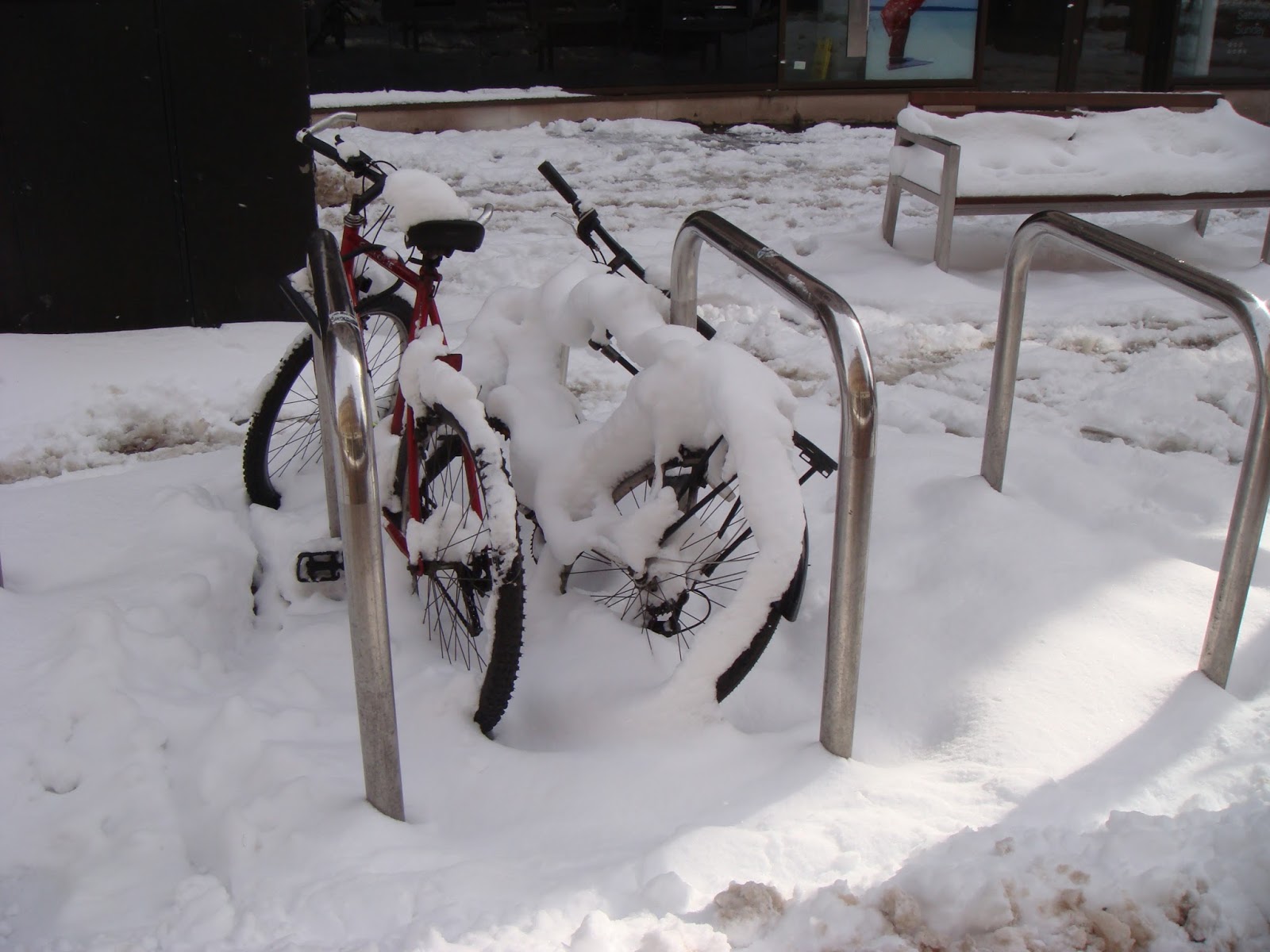
About a foot or so for Scots will do the trick. We're just not that used to it, so when it does come, everything stops.

The only outlets I saw open today were Mountain Warehouse (wishful thinking), Wagamama (the chef was out in the lane smoking), and of course the pubs. Everything else was snowed shut!

At any rate, I have never traipsed through the city with this much snow, at least here in Glasgow. When I lived in Warsaw, I had three glorious winters in a row like this, but of course, there, nothing closed or shut down.

So in the spirit of the slow flow of Glasgow, and even a little snow flow, a few photos of the snow-filled streets and dusted bicycles...


...


More Ships


This is the P222 patrol vessel which has just been fitted out at Scotstoun, having been put together over the last two years at Govan. Costing £116 million (small beer in today's militarized landscape), the MOD ordered three (you can see the P223 below), and they are now being sailed down to Portsmouth.


The P223 patrol vessel (used for anti-piracy and counter-terrorism) at Scotstoun, being fitted out before being sailed down to Portsmouth.


A Wilson (ferro) cargo carrier passing Dumbarton, taken  from Barscube Hill.


A Dutch cargo carrier leaving George V dock (with old Harbour Head crane in background).


Sacrificing Your Self

The art of sacrifice depends on one's ability to see correspondences in things. 

Tim Addey, The Unfolding Wings


'Thing' is a horrible word. It presupposes separation, isolation, alienation and demarcation. It is cold and alone, a thing. But since 'aloneness' is an aberration of Mind, so too is the 'thing'. Indeed, the 'thing' (as some have already suggested) is a monster... and a pretty horrific one at that.

Here, instead, in a universe of no-things, we have systems, and correspondences: reciprocities and mutualities. Everything is in everything else. The only question here is to what degree. Sacrifice depends on knowing this. Yet, as Tim Addey writes, sacrifice like prayer is in a terrible state of misunderstanding. 

When one becomes aware of this fundamental nature of the universe, one can understand how things are not merely things, but trans-things. In other words, things affect other 'things' simply by being. But understanding the essence of a thing is at the same time to understand that the human being is also not a thing, but an intricate system of subtlety that has evolved over great periods. Sacrifice can then occur through this knowing, as the making sacred (sacer + facere) of the self. This consecration is at first what appears to be a loss; in the Christian calendar we have Lent (marking the lengthening of the light) where people 'fast'. Yet, this 'fasting' (from Gothic 'fastan' to keep, to observe) is a matter of self-control and self-discipline, and of making of the self a disciple of the Earth. It is, in the grand scheme of systems, a re-turning to our natural way of being, observing the self, and not letting the self go, as is so easy to do in a society that has lost all sense of fasting and gone over to the dark side of excess, gluttony, and greed. 

 Just as prayer is a form of communion so too is sacrifice. 

'In sacrifice we conjoin ourselves to the convertive power of the universe in which all things - the most intellectual as well as the most material - are returned to their divine source... Sacrifice is a symbolic act which acknowledges our relationship... to the entire macrocosm'.

Insofar as this is concerned, sacrifice is all about getting over yourself...


Alone in the Open & The Shape of Water


You can't imagine how intensely I was living. How good it is to be on your own. You climb up and look back at your boat. There is the sea, the wind, the sound of the water. Above all, the beauty of the boat surging forward. On your own you can discover who you really are.

Bernard Moitissier


I have heard nothing. I have heard nothing. Donald Crowhurst


Around the world without stopping, eight months alone, completely alone, with all that that entails... Everything revolved around that word alone: the nervous tension, the food, the exhaustion, my whole outlook. Things which mattered at the start didn't matter at all now. The rules of the game had changed. The rules within me had changed.

Bernard Moitissier


Watching the fantastic documentary Deep Water (2006) the other evening about the amateur sailor Donald Crowhurst and his ill-fated attempt to circumnavigate the earth, I understood that 'to be alone in the open' is not just something I have felt (and celebrated through Being) in the hills and moors above my home city of Glasgow, but is a state of grace that is felt by many who have confronted the true nature of the Self. Whether on the planet's vast oceans, or in its deserts or mountain ranges, there is this sense of the boundless and limitless. And a rare glimpse of You.

Where a city has definite and definable limits the Self does not, in spite of our society's attempts to fashion otherwise. Yet, we have grown up in a world of hubris and arrogance against Nature (and nakedness) where we have not just been named (and thus specified quite unnaturally beyond the species) but where we have been fashioned and manufactured (by vestments and educations) to excel within that sphere of 'presumption towards the gods' (as in the dominion and control over all other entities). Through the remit of science and progress, we have (pathologically) measured and calculated, defined and demarcated, and in so doing lost the immense nature of the Self. One might suggest that it is nothing more than an aberration of Mind to want to measure everything, yet this, before anything else, is the mandate of the economic system we labour under. And the first 'thing' to be measured is the self. (There's a reason why the greatest horror film ever made is called The Thing!)

But how can you measure the immense? Where does the entity start and stop? A creature's perceptions and imaginations are proof that we are not limited to the sealed envelope of skin and skull. Only through being demented, and removed from Mind can we begin to package the entity with a straight face. Nowadays, dementia is a real problem and will prove to be an even bigger one as we continue through the 21st century in a similar 'Mindset' as to the previous two. Indeed, one might suggest that it is precisely because 'Mind' has set (and been awarded a definite article for its troubles) that we now find ourSelves in so much conflict.

The mind is now a bona fide commodity which trades itself on the global market through the purchase and the sale of its Self.

Yet, the mind is not Mind, and never will be until it can let go of itself, and embrace its immensity. It is this immensity that Crowhurst 'saw' towards the end of his voyage whilst penning his 25000 word thesis on the Cosmic Being. His 'racing' competitor Moitissier saw it too when he finally decided to abandon the race and return to the Pacific, and to the immense peace of the open seas, abandoning his waiting city-ridden wife and children in the process.

Part of this peace no doubt comes from the 'desert aspect' of being at sea (nothing reflected back to confirm the small-minded ago), and the fact that there are no 'pointers' to tell you that you are a 'man'. The scene is natural and immense: alone in the Open; primal scenery, no pylons, no roads, not a trace of modernity or progress (even the boat is primal, if we can compare it to an ancient dugout)... Primacy of Being then emerges naturally out of the primal setting. It is why so many go 'mad' when involved with such 'indefinition' and indifference. Yet this 'madness' is actually a clarifying of the immense Self, the in-difference of a violent ocean revealing the same-ness (or equally, identitylessness and voidness) that underlies the All.

It is an area full of paradox, the Open. The power of space enters, as does the power of privacy in plain sight. We have become too crowded as a species, and too scared of our immensity, and consequently sought safety in the herd. Yet, it is only through solitude, preferably in the Open, that one will come round to (and come to) the truth, and/or indeed love.

As the Mexican film-maker Guillermo Del Toro insightfully remarked today in an interview with Radio 4's Francine Stock promoting his new film The Shape of Water: 

We cannot live without water, we are 90% water... And I must say, we cannot live without love... Seriously, we are 90% love; when you are in love you don't need anything, and this is not just a song The Beatles came up with, it's a fact. When you need the car, need the salary, need the recognition, you are 100% not in love. When you are in love, not just infatuation, real love, you really don't need anyone or anything except that person.


That 'person' is the Open...