Totem

Find the contours of the first man, the absolute savage; scrape off, with the slow wear of these forest walks, the social man's varnish... draw that first man.

[Frederic Gros, A Philosophy of Walking]


Perhaps, collectively, man is subject to an inevitable self-destroying madness, if he does not question and understand the real purpose of his existence.

[William Corlett & John Moore, The Islamic Space]


Much of the real work involved today is a sort of existential exfoliation and relieving your Self of the identity-package that your 'you' has been encrusted with. Whether it's Gros urging us, Thoreauvian-like, to scrape away the varnish on forest walks (the clearest way into the universe is through a forest wilderness) or Corlett & Moore urging us to question and understand, there's a lot to be said for a little kenosis, kinetics, and questioning.

The great metaphysical cleansers and existential exfoliants are auto-mobility (moving-thinking under your own steam), space (as the absence of blockage), silence (as the absence of ‘noise’), and solitude within landscapes (as an opportunity to see your original self).

Modern society is diseased. In the current climate of techno-worship and individualism, society has lost touch with its togetherness, and conviviality. A rampant godlessness, shot through by the media and corporate messaging, has led to the desecration of the human being, his animal brethren, and the land that feeds and shelters both.

‘Our entire society’, writes Jerry Mander in the 1991 edition of In the Absence of the Sacred, ‘has begun to suffer the madness of the astronaut; uprooted, floating in space, encased in our metal worlds, with automated systems neatly at hand, communicating mainly with machines, following machine logic, disconnected from the earth and all organic rality, without contact with a multidimensional, biologically diverse world and with the nuances of world views entirely unlike our own, unable to view ourselves from another persepctive, we are alienated to the nth degree’.

A quarter of a century later, with the explosion of the internet and the flurry of social media, our existential alienation, and what Mander refers to as our ‘intra-species incest’, continues unabated at an alarming pace.

As aliens to our more convivial, more conscientious selves (the western world is now one of ‘science’ not ‘con-science’), we have no vested interest any longer in maintaining our planet. Like a child that has been removed from its mother at birth, people are kept in the dark as to their true parentage by the machinery of progress.  But society has commodified our common Mother. It has commodified space, time, nature, and the human being. Animals too, when they haven’t been moulded into ‘pets’ in order to stabilise one’s lop-sided life, are produced like products in order to appease our ever-burgeoning fragmentation.

For the first time in millions of years we have been largely separate from our animal cousins, and this has had devastating effects on them and on us. I have heard children as old as ten speak of sheep as white dogs; children unable to identify local birds or plants but who can easily identify specific corporate logos and slogans. Children who simply do not know what food is, never mind where it comes from. The list goes on and brings you to tears.

Modern society is based on lies and deception. On utility not unity. Our whole society's foundations are steeped in dishonesty and untruthfulness: duplicitous histories, and crowbarred cultures, inveigling their way into our living. The obesity epidemic in western cultures is due precisely to this sort of deceitfulness. Being ferried around in an intoxicated state, we simply do not where we are anymore.

The totem brings us back down to earth. It sobres us up, ontologically, phenomenologically, existentially. It is rooted like a tree into the soil. It has branches and limbs, eyes and ears. It is human, tree, and animal, all rolled into one. It is silent and still. It confers upon us the power of all animality, the power of being animated and the power of animated being. The totem knows that which we apparently do not: that the human being is only a human being in contact and conviviality with what is not human.

The totem is alive, just as an idea is alive. It re-minds us. Not of anything in particular, but simply to render us mindful once more. Like a mirror of the greatest magnitude, it allows us a glimpse of the great-souled self cleared of the claptrap. And like a poem, it offers us the opportunity for contemplation, and universal disclosure. As far as this is concerned, these words and drawings - healed wounds, scars in the shape of words and images, after the bandages of civilization have been removed - are more of an ‘existential memo’ than anything else, a prophetic record of the essential and the necessary.

In an increasingly analytical and anti-contemplative society where your naked existence is scorned upon and has no value, the totem pole, as a reminder of our unity and universality, as a symbol of a new worldview (which is actually quite ancient) could not be more important, could not be more vital.

So clear it away, I say. Empty the mind. Welcome space into your thinking. Welcome non-thinking as the epitome of contemplation. Maybe then, you will see your original face staring out at you, from between the face of a fox and a bear, on the great tellurian totem pole.




Up the Clyde in a Banana Boat


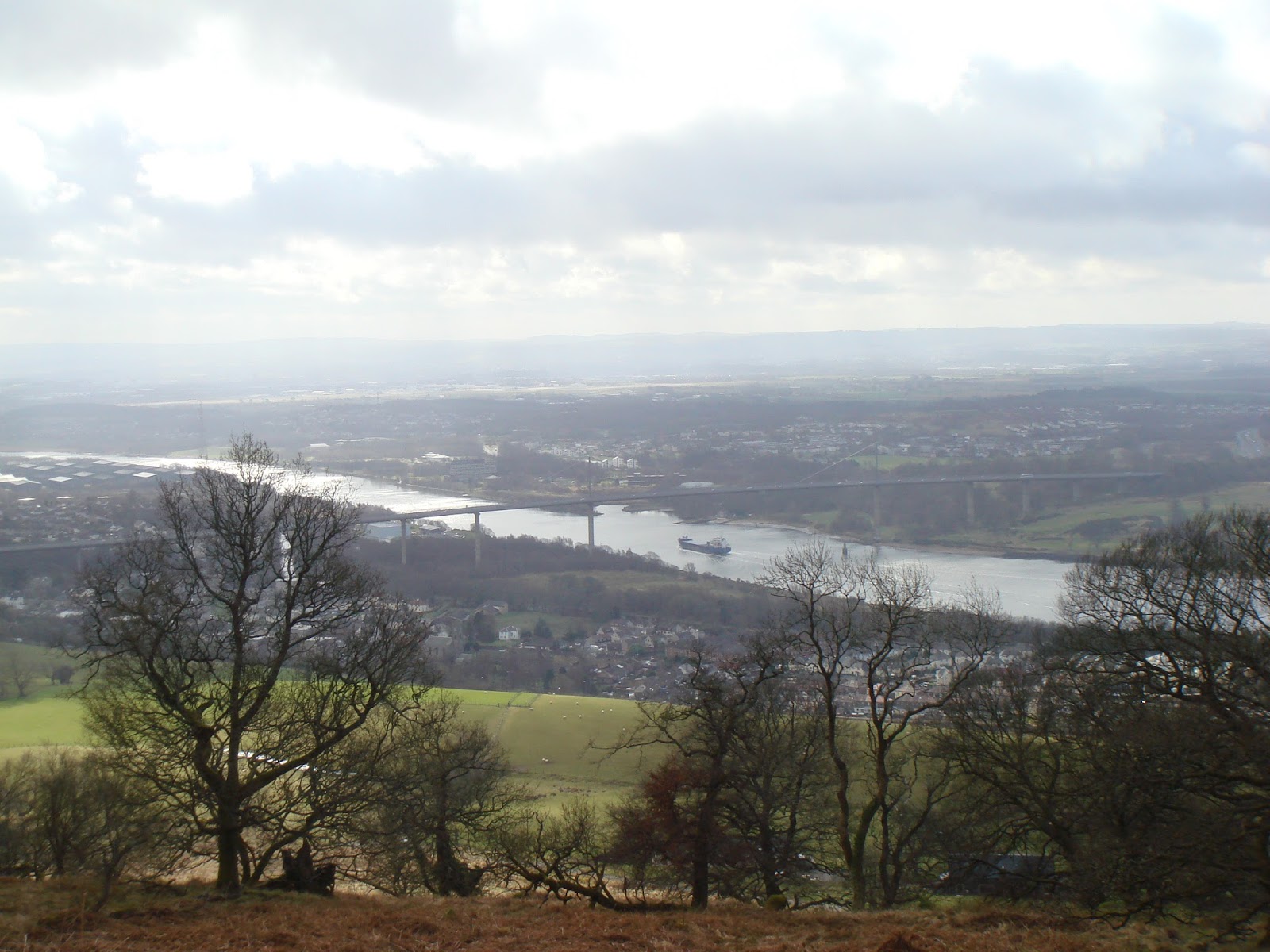
The Erskine Bridge is something of a landmark in the valley of the Clyde. Once upon a time, long before its construction, the river used to be teeming with all manner of water craft. Indeed, further along towards the city, there used to be so many ships and boats on the river that it was often difficult to see the water. Naturally, the pollution was atrocious, and sightlines limited. Not so, in the early part of the 21st century. Here, I have collated a few photos of ships passing under the Erskine Bridge over the past few years since I started noticing them from my perch up here in the Kilpatrick Braes. I have seen dredgers, cargo ships, tankers, fishers, leisure boats and tugs, and a flotilla of yachts coming up river for the Commonwealth Games (as well as the odd nugget on a jet ski). Though the traffic is a lot thinner than yesteryear, the ships still come from all over, and it's quite amazing to check up on them and their routes (see Live Ships Map, https://www.marinetraffic.com/en/).


The title to this post refers to an old Glaswegian phrase "D'you think ah came up the Clyde in a banana boat?!" This has various interpretations (mostly with racist overtones), but the most believable in my opinion is that Fyffes used to export bananas from Jamaica to Glasgow, and when the bananas arrived they were green, (ripe bananas leaving the West Indies would have gone off by the time it reached Scotland). The phrase refers then not to the poor galley hands and sailors (who were probably also green after a long crossing), but to the banana itself, the phrase being akin to "Do you think I am as green as I am cabbage looking?" 

 No racism, but maybe banana-ism.


There's something remarkable about seeing ships this size stroll into Glasgow along the Clyde. Like watching birds, watching ships gives us an inkling of a larger more expansive world. Naturally, birds are a whole lot more in keeping with a healthy earth (ships have caused some of the most appalling ecological disasters in history), but that doesn't mean I can't watch them and wonder.

The Kilpatrick Braes (near the top of the Loch Humphrey Path), from where all of these photos were taken, is an excellent perch from where you can inhale the movements of the estuary.


The Dechmont Kestrel


My camera skills (or lack thereof) notwithstanding, this is a cracking little video showing the epic views from the subtle Dechmont Hill behind Cambuslang, and introducing the Dechmont Kestrel in its first starring role....


The Kilpatrick Brae Buzzards


The Kilpatrick braes are a quiet place to be.  That is, if you go during the week, and manage to get off the Loch Humphrey path (which is more like Sauchiehall Street on the weekend). 

Indeed, when I come up here, maybe twice a week or so, by train and bicycle - locomoting and locating - I feel that I have more in common with the buzzards or ravens up here than I do with my fellow man. My fellow man no longer locomotes, no longer locates, no longer taps in to the spirit of a place because of his existential stabilisers (dog, pram, phone, car) that blind him to it. My fellow man no longer walks, he is carried. He no longer sees, he looks at. He no longer thinks, but is thought.

As such, he stays on the path of convention, and can no longer appreciate the pathless land.

These birds, on the other hand, all they have is the pathless, all they have is seeing...

There are benefits to be had from getting off the beaten path.


Anima l


One of the great difficulties of being human in an all too human world is realizing your fundamental animality. Within the rush and roar of modern society, it's often very difficult to tap into one's primordial essence. The required ingredients of remoteness, solitude, quietness, and wilderness are all too often too far out of reach from the confines of the city. Yet, it is the responsibility of very human to re-engage their original essence, and their aboriginal aliveness in the form of animal-being.


The key attributes of 'animal' are as its etymology suggests: a highly tuned sense of movement (agility, nimbleness, balance, stillness), and an equally highly tuned sense of consciousness (perception, awareness, wits, wherewithal) ...

This highly tuned nature of these attributes is what distinguishes animals from people. In terms of movement and consciousness, people are rather sluggish in comparison to animals. Their level of animation has been hindered by too much 'progress', and too much outsourcing to technologies that propose to do it for us. Animals on the other hand have never really gone in for this type of outsourcing, have never really given in to the dubious proposition that 'having technology' is better than 'being alive'.

As a result, animals are in constant touch with their environment, for they know that this is what feeds and shelters them, what effectively allows their aliveness. Humans, on the other hand, in their arrogance and egregiousness (in their removal from the flock of all animals), have decided in their infinite wisdom (which isn't wisdom at all but rather disconnected facts) that the domination of nature and their fellow animal kin is no big deal. In this grand perversion of the natural flow, the human animal has almost been extinguished (entirely dammed up), with 'deluded man' (Homo mendax) stepping in to take his place. This Homo mendax, as his title now suggests, is the problem, for he not only deceives others but also his own self. This deception is at the root of the biblical 'devil' or any other demon for that matter. To deceive is to demonise, and to bedevil. And sadly, within a rapacious world of advertising, sensationalist media, and the big sell, deception, in their various guises, is rife.

It is only by re-engaging 'anima' - hyper-critical thinking and hyper-critical moving - that we will have any chance of exorcising these demons from the world, and embracing, not the beast, but the animal within. It is every human's responsibility.


The Clearest Way into the Universe

The clearest way into the universe, Thoreau once wrote, was through a forest wilderness. 

Sadly, for we Scots, most of our forests have long been felled, and what remains of them is surely not a forest but a remnant, and vestigial limbs of a once tree-covered land. Yet, I know what Thoreau means. One of my greatest and most profound epiphanies (see The Map is not the Territory post) occurred whilst wandering through a forest in the Suwalki region of north-eastern Poland. In the forest city of Warsaw, where I lived and wandered freely for three whole years, I had many magical moments in the primeval las and pusczca of Bielanski, Kampinoski, Mazoviecki, Slupecka, and even in the rather regimented Las Kabacki. Indeed, even in the elegantly ornamented Royal Lazieki Park, where the old growth trees encouraged and enabled a greater spread of bird and general wildlife (from deer to boar and foxes), I could recognize, without too  much effort, the universe in front of me. 

It was the entanglement that did it.

This entanglement, though not so readily available in forest format in Scotland, is available in other ways. I, personally, get it from the tops of hills, from being enclosed not by a canopy of trees and their various inhabitants, but from being enveloped (or maybe, embraced) by the biosphere and its elements, the often cloud-laden sky, and those sledgehammer panoramas. I get it through gazing upon the vast landscapes that peel away before me and those bare-faced vistas. To be sure, I still yearn for forests - real forests that are so large that getting lost can often mean getting dead, and not a few trees clumped together as some sort of pitiful monument to the fallen and felled - but so long as I am in Scotland, I will have to make do with the hills, which to my cosmic mind are Poland's wonderfully enchanted forests.


The Polish capital Warsaw from Siekerki Bridge...


The cultural capital of Scotland (where culture is defined in terms of nature and not tourism), Glasgow, from the Kilpatrick Braes (an angle that is just not possible in Warsaw unless you climb the few artificial tells (or the rubbish dump!) that are dotted around the city.


Planet Dialectics: The Search for Selective Slowness

The environmentalist and former chairman of Greenpeace Wolfgang Sachs begins his book, Planet Dialectics, with a look at our planet from space, defining its boundaries and revealing our home as one of finiteness and a limited carrying capacity. This much we know already, surely. But he goes on, in amongst all the statistical critiques of western civilization, to use this idea of limits and boundaries to propose the only real solution to the ills of our species: intelligent self-limitation.

'As the dangers mount,' he writes, 'new products, procedures and programmes are invented to stave off the threatening effects of industrialism and keep the system afloat. Capital, bureaucracy and science - the venerable trinity of western modernization - declare themselves indispensable in the new crisis and promise to prevent the worst through better engineering, integrated planning, and more sophisticated models.'

This is exactly what the more astute members of the human race are saying, because they can see beyond the nonsense and the clutter. Jim Kunstler, in his book The Long Emergency, tells the same story: that the ecological crisis simply demands, not to take care of nature and recognize our limits, but to devise new ways of doing the same thing whilst optimizing the exploitation of nature (our own presumably included). Kunstler riles at such thick-headedness, and states quite unapologetically, that the orgy of excess is over, and that if people en masse do not start toning things down, then there will be blood, lots of it: from the land, the animals, the people.

'Calls for the survival of the planet', writes Sachs, 'are often, upon closer inspection, nothing more than calls for the survival of the industrial system'.

In one of the later chapters entitled 'Speed Limits' Sachs introduces what Aldous Huxley called the only real innovation of the 20th century, speed, and relates how it is 'speed' that has caused many of our ills.

'In the machine age,' writes Sachs , 'neither the body nor the topography defines a natural measure for speed. As a consequence, the modern idea that human motion was set on an infinite path towards ever increasing acceleration was able to take hold.' He understands from this, as I have iterated earlier, that through speed and conveyance, space is bludgeoned, effectively creating a 'new layer of reality' and a new 'perceptual space', one which has the tendency to blur the underlying reality, when it doesn't entirely blind you to it. In other words, we have floated off into a sort of fantasy land where our perceptions of underyling realities have been mutilated by the machine, and as a direct result, our consciousness is hindered and stunted.

'Generally speaking, the ecological crisis can be read as a clash of different timescales: the timescale of modernity collides with the timescales that govern life and the earth'.

Consequently, life (at large) and the earth are being constantly 'reduced' to meet the limited corporate objectives of a mechanically minded and speed-oriented world. 'The imposition of industrial time on natural rhythms', Sachs concludes, 'cannot be achieved without a staggering price.'

'The more speed outdoes natural timescales, the more environmental resources - at a rather exponential rate - have to be expended.'

Speed, Sachs acknowledges, like Keynes before him, has been the great con of the 20th century, promising to free up time that we can use on leisure, but actually doing the reverse: accelerating us into a space that we invariably fill in with more work. The result is a natural disempowering of the self and its connections, and the resulting existential distress that accompanies this.

'It is unlikely that a society that always moves in the fast lane can ever be environmentally or even socially sustainable'.

'The conclusion is inevitable,' writes Sachs: 'Whatever virtues justice might require in the world of today, the search for selective slowness surely figures among them.'